Public Transport in Phuket
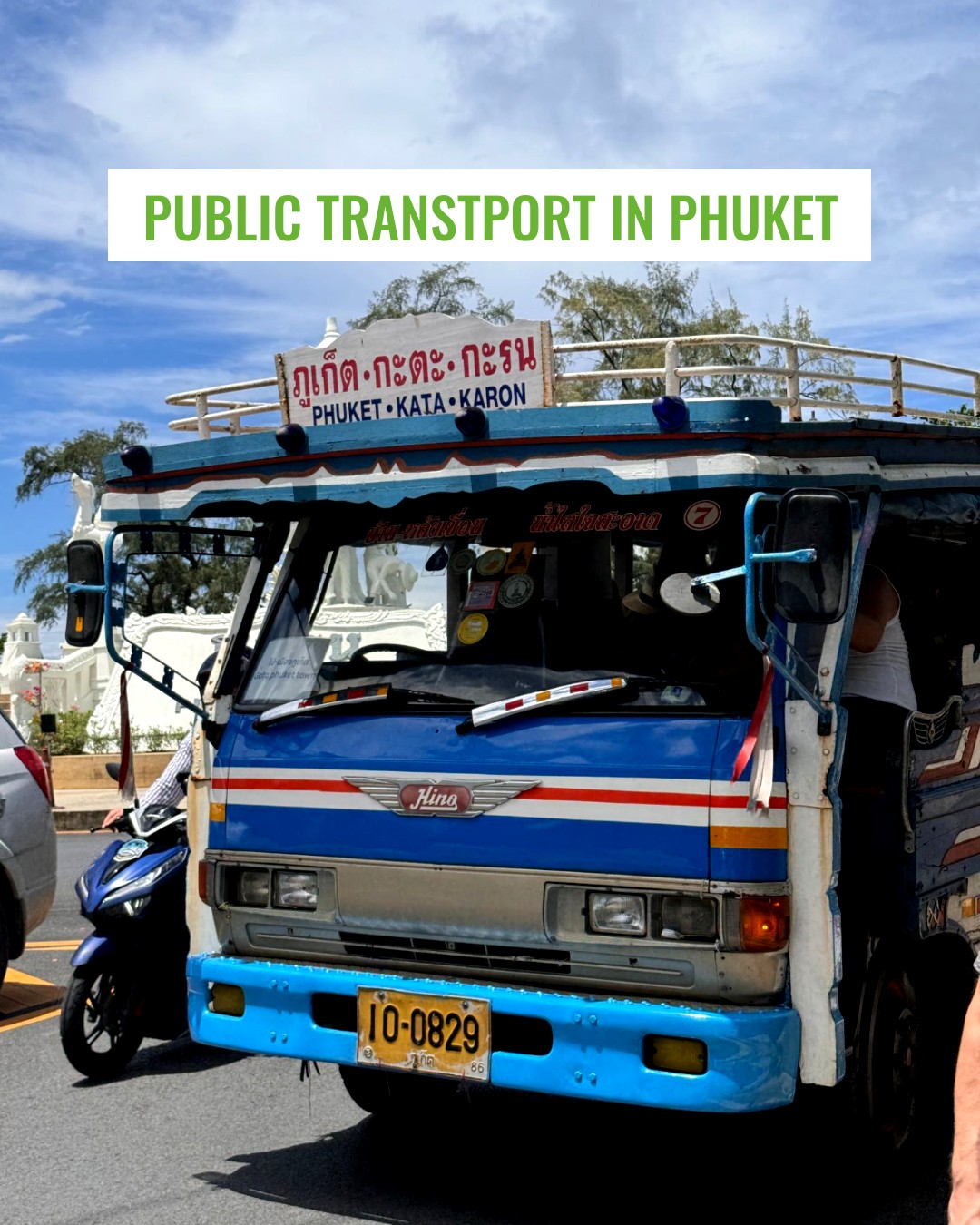
Public transportation in Phuket for tourists is something of a mystery and, honestly, not very popular. From Phuket Airport, you can travel on a budget by local buses to various parts of the island. They stop near the local terminal, right on the street opposite the entrance. Signs will help you find your way. This is probably the only use case of public transport that an Insider would actually recommend. Still, let’s take a closer look at public transportation in Phuket.
Smart Bus. The route starts at the airport and ends at Rawai Beach. The stop is located near the local terminal. The bus passes by all the major beaches. Fares range from 50 to 170 baht. You can buy a card from the driver for 300 baht (100 baht is a non-refundable deposit). One card is valid for only one passenger. Sometimes the driver may accept cash.
The route can be tracked on Google Maps, as the buses are equipped with GPS. The bus is comfortable, with air conditioning, a TV, and a schedule leaflet and map of Phuket at every seat.
The journey from the airport to the final stop takes about 2 hours. During high season, a Night Smart Bus also runs between Kamala, Patong, Karon, and Kata beaches. It operates once an hour from 9:00 AM to 2:00 AM. The fare is 50–150 baht.
The most authentic form of public transport in Phuket is the songthaew, which literally means “two benches”. It’s a modified pickup truck with a metal roof and a cargo area fitted with three long benches. The windows are covered with canvas or plastic in bad weather, and there are no doors — the entrance is open at the back.
Pros: very cheap (20–50 baht depending on distance) and quite exotic.
Songthaews pass by Central Festival Mall and allow you to see island sights along the way. Cons: limited capacity, restricted operating hours (from 6:30 AM to 6:00 PM), intervals of 20–40 minutes, and — most importantly — a very unclear schedule, or rather, no real schedule at all.
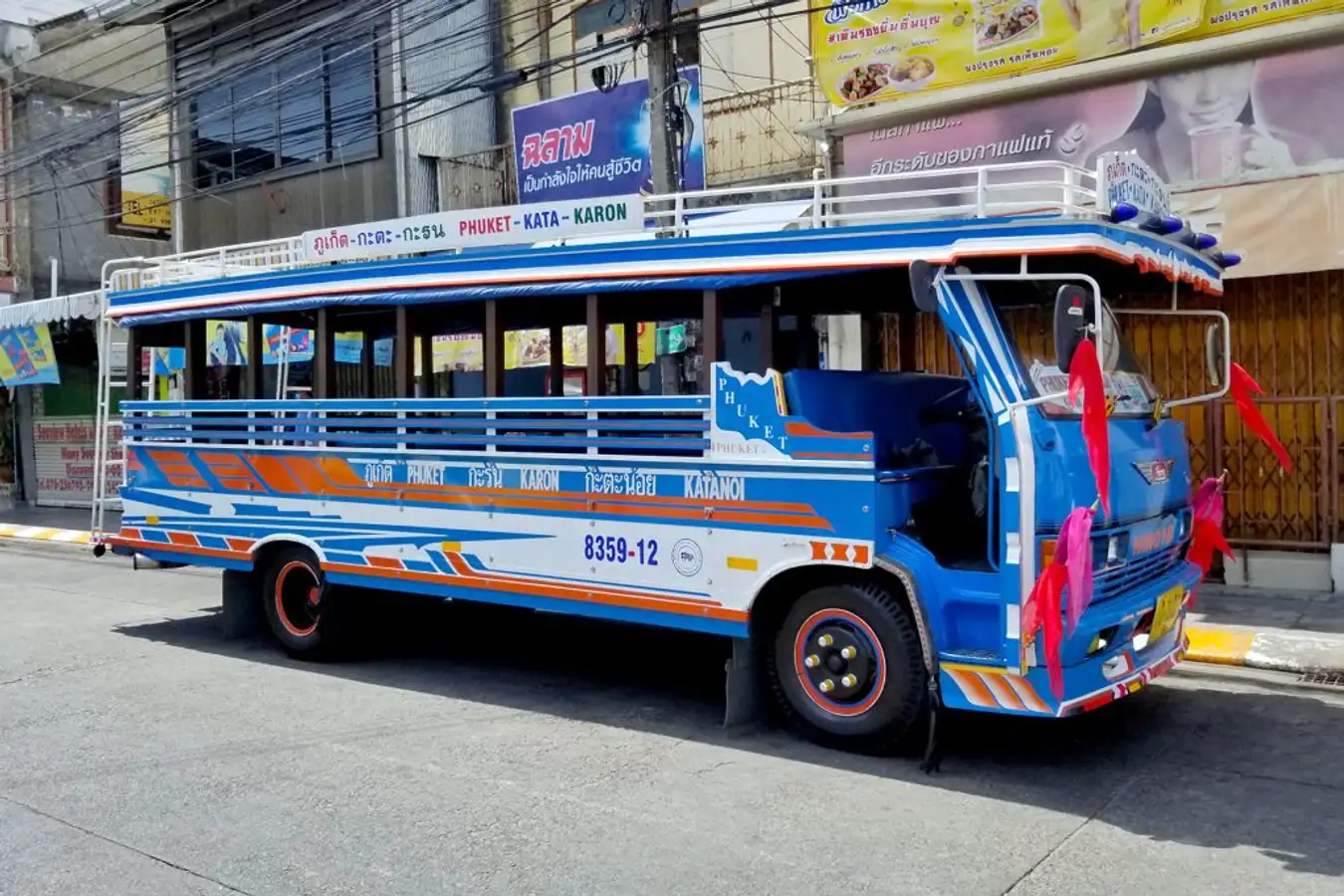
There’s no point in looking for official stops: when you see a blue vehicle, wave it down and try to get the driver’s attention.
Conditions are rather basic: wooden benches inside, often crowded with locals carrying bags, boxes, and groceries. Once inside, always clarify whether the songthaew is going in the direction you need by clearly stating your destination. Stops are on request, so tell the driver or use the bell on the roof. The bus will stop as soon as traffic rules allow. You’ll need to pay for the ride at the end of the trip — just hand the coin to the driver. Blue songthaews depart from Phuket Old Town along the routes listed below.
Relevant bus routes in Phuket for tourists:
- Phuket Town – Patong
- Phuket Town – Bang Tao – Surin – Kamala
- Nai Harn – Rawai – Phuket Town
- Phuket Town – Karon – Kata
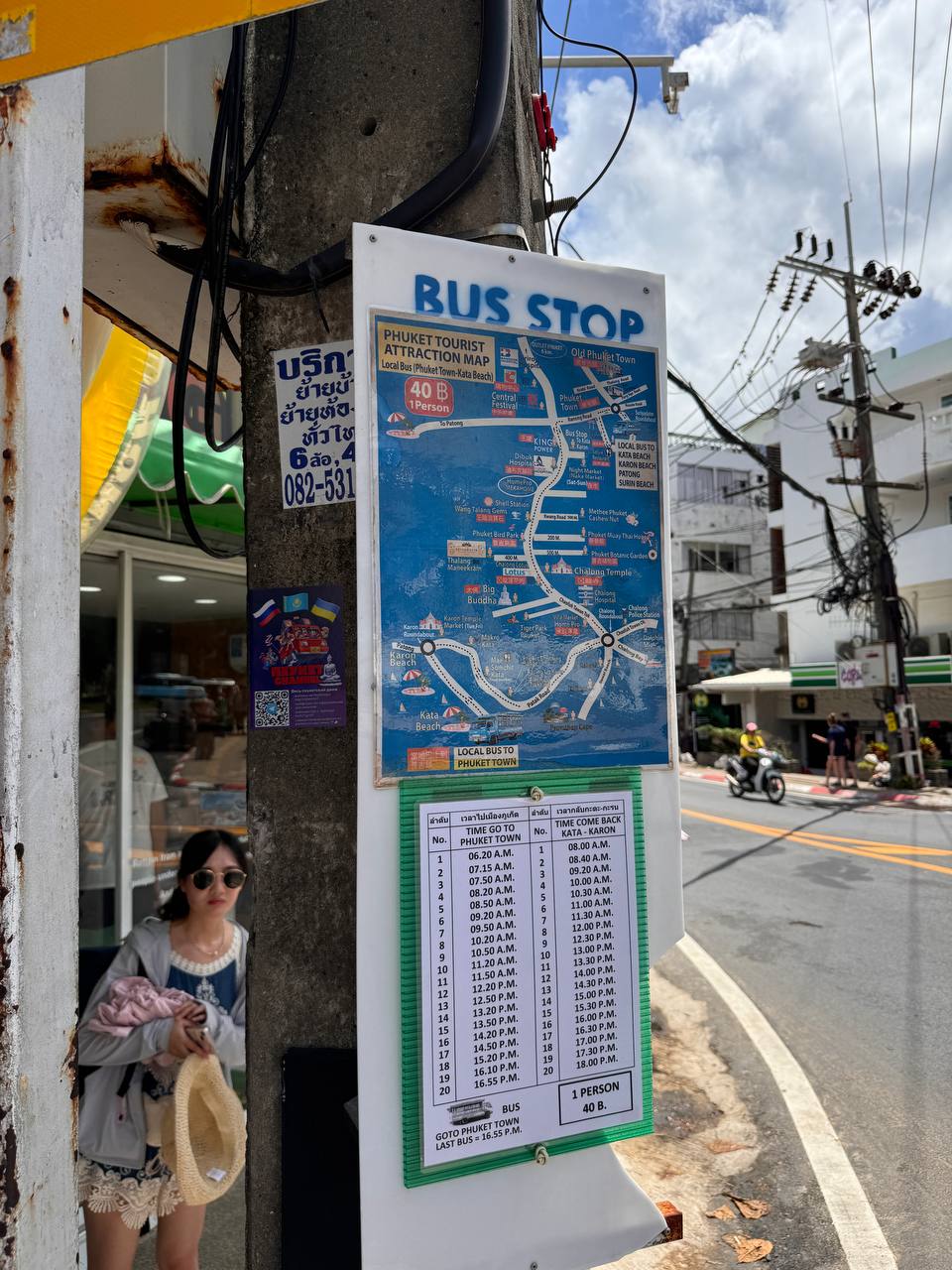
At some stops, you may see timetable signs — and hope the buses actually follow them:
There are also pink songthaews. The fare is 15 baht. These are convenient for sightseeing around Phuket Town, getting to shopping malls from Ranong Road station, or reaching Rassada Pier, where ferries depart to nearby islands. Pink buses operate from 6:30 AM to 8:00 PM every 20–30 minutes.
Phuket has several bus routes, but there are no familiar route numbers. Instead, the names of major beaches are written on the windshield, roof, or sides of the buses. Some routes have signage only in Thai — these are intended for locals and do not go to tourist beaches or attractions.
Recently, comfortable air-conditioned minibuses have started running from the old bus terminal in Phuket Town to Patong. Unlike songthaews, the white-and-green minibuses run strictly on schedule: every hour from 7:00 AM to 6:00 PM from the terminal, and from 6:00 AM to 6:00 PM on the return route.
There is also a sightseeing “tram” in Phuket. In reality, it’s a tram-styled vehicle that loops around the historic center of Phuket Town. The ride is free.
Starting in 2025, construction of a full tram infrastructure is planned on the island. According to local authorities, it will significantly improve transportation and help reduce traffic congestion.
Why most tourists do NOT use public transport in Phuket
- Unpredictable schedules. Services are often irregular, especially on secondary routes.
- Slow and time-consuming. Due to circular routes, detours, and waiting times, trips can take 2–3 times longer than taxis.
- Inconvenient with luggage. Especially in the rain or with suitcases.
- Language barrier and unclear routes. Many signs are only in Thai, with no route numbers.
- Limited coverage. Some areas and beaches are not served at all.
- Limited operating hours. Often not an option late at night or early in the morning.
- Lower comfort level. Hard benches, lack of air conditioning, overcrowding — especially uncomfortable in the heat.
When public transport does make sense
- You’re a budget traveler or backpacker.
- You’re not in a hurry and have a flexible schedule.
- Your route is between popular beaches or between Phuket Town and a beach served by buses or songthaews.
- You want an authentic local experience.
When it’s better to take a taxi
- You need to get somewhere quickly.
- You have luggage or equipment.
- You’re traveling in a group of three or more.
- The weather is bad (heat or rain).
- You need flexibility.
- You value comfort, safety, and minimal hassle.
If independence in getting around the island is important to you, the best option is to rent your own transport.